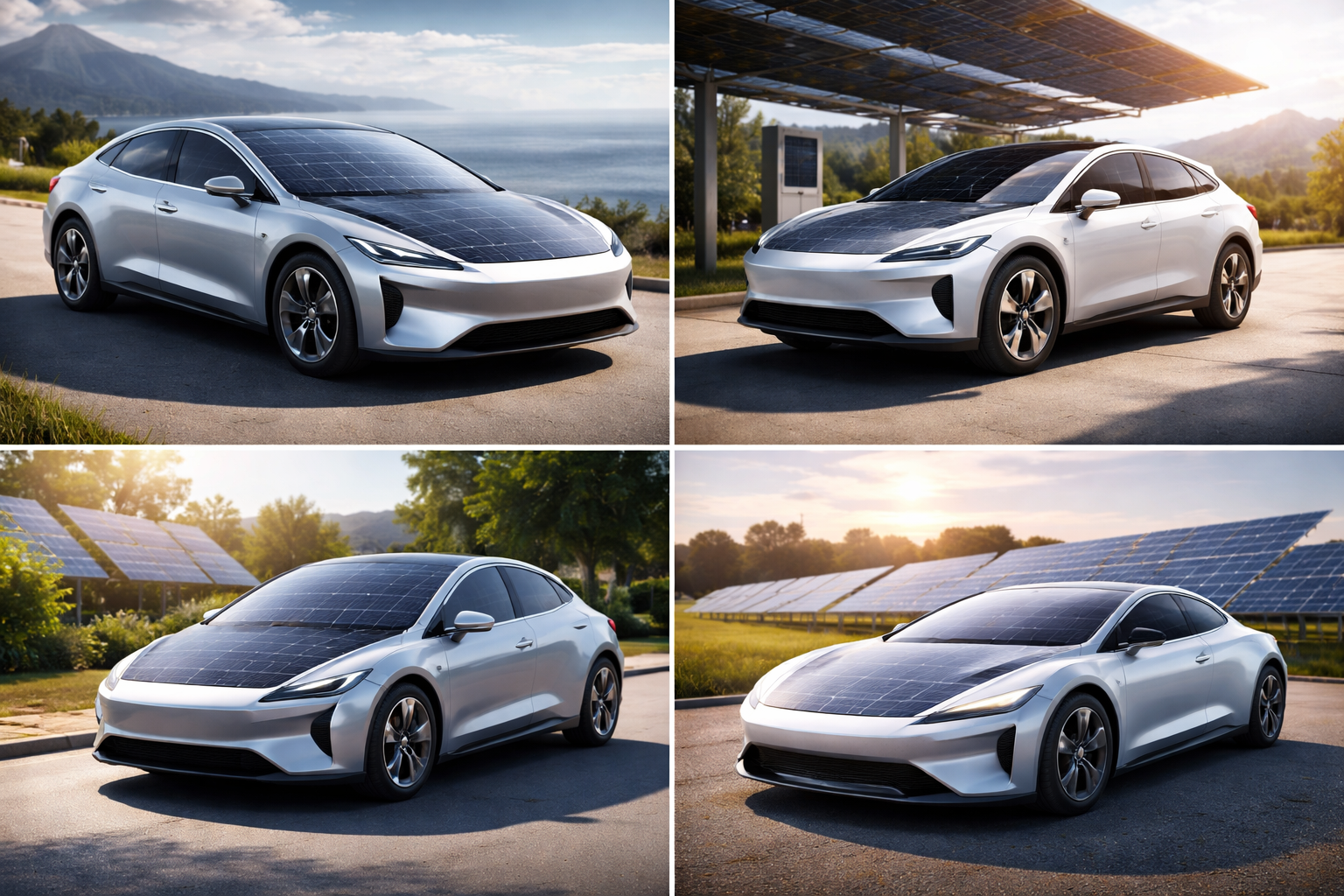
Interest in solar powered cars has grown alongside rising fuel costs, urban pollution concerns, and the expansion of electric mobility. While battery electric vehicles are becoming common, the idea of a car that can generate its own electricity from sunlight still feels futuristic to many people. Solar powered vehicles are not entirely new. Engineers have experimented with solar race cars since the 1980s, and recent advances in lightweight materials, photovoltaic efficiency, and battery storage have moved the concept closer to everyday transport. Today, several startups and research groups are building solar-assisted passenger vehicles, and many electric cars can already benefit from solar charging infrastructure.
What is a solar powered car?
A solar powered car is a vehicle that uses solar panels to convert sunlight into electricity. That electricity can either:
-
Directly power the motor
-
Charge the vehicle’s battery
-
Extend the range of an electric vehicle
Most modern designs are solar-assisted electric vehicles, meaning they combine solar panels with rechargeable batteries rather than relying solely on sunlight.
How the technology works
Solar powered cars depend on three main systems working together.
1. Photovoltaic solar panels
Solar panels contain photovoltaic cells that convert sunlight into electrical energy. These panels are typically mounted on:
-
The roof
-
The hood
-
The rear deck
-
Integrated body surfaces
Because vehicle surface area is limited, solar panels usually generate only part of the energy needed for driving.
2. Power electronics and control system
The electricity produced by solar panels must be regulated before it can be stored or used. This system:
-
Converts panel output into usable voltage
-
Manages charging efficiency
-
Prevents battery overcharging
-
Distributes energy between battery and motor
3. Battery and electric drivetrain
Most solar vehicles use lithium-ion battery packs similar to electric cars. The battery stores solar energy and powers:
-
Electric motor
-
Onboard electronics
-
Climate systems
Without batteries, the car could only operate in bright sunlight.
Charging methods for solar powered cars
Solar vehicles rarely rely on just one charging source. Instead, they use a combination of approaches.
Direct solar charging
Panels mounted on the vehicle produce electricity whenever sunlight is available. This method:
-
Works automatically
-
Requires no external infrastructure
-
Produces limited energy daily
Typical solar roofs generate enough power for short daily distances, often between 10–40 km depending on sunlight and efficiency.
Solar charging stations
Drivers can charge their vehicles at solar-powered charging stations or carports. These stations:
-
Use rooftop photovoltaic arrays
-
Store energy in batteries
-
Provide standard EV charging connections
This approach supplies much more energy than vehicle-mounted panels.
Home solar system integration
Owners with residential solar panels can charge their vehicles using rooftop systems. This is currently one of the most practical solar mobility solutions because it:
-
Provides consistent charging
-
Reduces electricity costs
-
Uses existing EV charging infrastructure
Grid backup charging
Nearly all solar vehicles still include standard electric charging capability. Grid charging ensures:
-
Reliability during cloudy weather
-
Faster charging times
-
Long-distance travel support
Benefits of solar powered cars
Solar mobility offers several advantages, though many depend on location and usage patterns.
Reduced energy costs
Once installed, solar panels generate electricity without fuel expenses. Over time, this can reduce the cost per kilometre of driving.
Lower environmental impact
Solar energy produces no direct emissions during use. When combined with electric drivetrains, solar vehicles help reduce:
-
Urban air pollution
-
Greenhouse gas emissions
-
Dependence on fossil fuels
Extended driving range
Solar roofs can add small amounts of range each day. For short urban commutes, this may significantly reduce charging frequency.
Energy independence
Drivers can rely less on public charging infrastructure or fuel stations. In sunny regions, solar generation can cover a portion of daily travel needs.
Quiet and efficient operation
Like other electric vehicles, solar cars benefit from:
-
Smooth acceleration
-
Low mechanical noise
-
High drivetrain efficiency
Limitations and challenges
Despite the appeal, solar powered cars face practical constraints.
Limited surface area for panels
A car simply cannot hold enough solar panels to power long drives. Even highly efficient panels produce modest daily energy compared with battery capacity.
Weather dependence
Cloud cover, seasonal changes, and shading significantly affect energy production. Solar vehicles work best in regions with strong sunlight.
Higher production cost
Integrating solar panels into vehicle bodies requires:
-
Special materials
-
Lightweight construction
-
Advanced power electronics
This can increase manufacturing costs.
Efficiency trade-offs
Solar panels add weight and complexity. Designers must balance aerodynamics, safety, and energy output.
Charging speed
Solar charging is slow compared with plug-in charging. It works best as a supplemental energy source rather than a primary one.
Types of solar powered vehicles
Solar mobility includes several distinct categories.
Fully solar experimental vehicles
These are often research or competition cars designed to run mainly on solar power. They prioritize:
-
Extreme efficiency
-
Lightweight design
-
Aerodynamic shapes
However, they are rarely practical for everyday use.
Solar-assisted passenger cars
These vehicles combine batteries with integrated solar panels to extend driving range. This is the category closest to consumer adoption.
Examples include prototypes from companies such as
Lightyear,
Aptera Motors, and
Sono Motors.
Solar charging infrastructure vehicles
Many conventional electric vehicles benefit indirectly from solar energy by charging at solar-powered stations or homes.
This approach currently represents the most widespread form of solar mobility.
Latest trends and innovations
Solar vehicle development has accelerated due to advances in multiple technologies.
Higher efficiency photovoltaic cells
Modern solar cells are significantly more efficient than earlier versions, producing more power from smaller surfaces. Flexible and curved panels now allow integration into vehicle bodies.
Lightweight composite materials
New materials help offset the added weight of solar panels. This improves energy efficiency and driving range.
Improved battery density
Better battery energy density allows solar input to have a more noticeable impact on total range.
Integrated vehicle-to-home systems
Some designs allow solar vehicles to supply electricity back to homes or grids, supporting broader energy independence.
Solar body integration
Instead of placing panels only on roofs, newer designs embed solar cells across multiple body panels to increase energy capture.
Key features to consider
Anyone evaluating solar mobility solutions should look at several factors.
| Feature | Why it matters |
|---|---|
| Solar panel output | Determines how much range can be added daily |
| Battery capacity | Affects driving range and energy storage |
| Vehicle efficiency | Lower energy use increases solar contribution |
| Charging flexibility | Important for long trips and cloudy days |
| Climate suitability | Sunny regions benefit more from solar vehicles |
| Warranty and durability | Solar panels must withstand weather and vibration |
Top companies and solutions
While the solar car market is still developing, several notable efforts exist.
Solar vehicle developers
-
Lightyear – Developed long-range solar-assisted EV prototypes
-
Aptera Motors – Focuses on ultra-efficient aerodynamic solar EVs
-
Sono Motors – Designed a solar-integrated commuter car concept
Conventional automakers exploring solar integration
Some mainstream manufacturers have experimented with solar roofs that power ventilation or auxiliary systems rather than driving the car directly.
Solar charging infrastructure providers
Many renewable energy companies now install solar carports and EV charging systems for homes, offices, and public areas, which may ultimately play a bigger role than solar-only vehicles themselves.
How to choose the right solar mobility option
Since fully solar cars are still emerging, users should evaluate solar mobility in practical terms.
Step-by-step checklist
1. Evaluate driving habits
-
Daily commute distance
-
Urban vs highway driving
-
Parking in sunlight vs shade
2. Assess solar availability
-
Average sunlight hours in your region
-
Rooftop or parking solar potential
-
Seasonal weather patterns
3. Consider infrastructure
-
Access to EV charging
-
Possibility of home solar installation
-
Workplace charging availability
4. Compare cost vs benefit
-
Upfront solar installation cost
-
Expected energy savings
-
Vehicle efficiency improvements
For many users today, the best solution is still an electric car combined with home solar charging.
Tips for best use and maintenance
Solar vehicles require both electric vehicle care and solar system awareness.
Usage tips
-
Park in sunlight whenever possible
-
Keep solar panels clean for maximum efficiency
-
Monitor charging performance regularly
-
Use grid charging strategically for long trips
Maintenance tips
-
Inspect panels for scratches or debris
-
Follow manufacturer battery maintenance guidelines
-
Avoid covering panels unnecessarily
-
Ensure wiring and seals remain intact
Solar systems generally require little maintenance, but neglect can reduce efficiency.
Frequently asked questions
Do solar powered cars run entirely on sunlight?
Most do not. They use solar energy as a supplement while relying on batteries and plug-in charging.
How much range can solar panels add?
Depending on efficiency and sunlight, integrated panels may add roughly 10–40 km per day.
Are solar cars available to buy today?
Some prototypes exist, and limited production models are expected, but the market is still developing.
Are solar vehicles practical in cloudy regions?
They can still function as electric vehicles, but solar benefits will be smaller.
Is home solar charging better than built-in panels?
For most users, yes. Rooftop solar systems provide far more energy than vehicle-mounted panels.
Conclusion: The realistic future of solar mobility
Solar powered cars represent an exciting step toward cleaner transport, but their role is likely to be gradual rather than revolutionary. Current technology makes fully solar-driven cars difficult for everyday use, yet solar-assisted vehicles and solar charging infrastructure are already practical solutions.
In the near future, the most effective approach may combine efficient electric vehicles, home solar charging, and improved battery technology. As photovoltaic efficiency rises and vehicle energy consumption falls, solar power will likely become an increasingly meaningful part of the transportation ecosystem.
For users today, understanding how solar mobility works helps separate practical solutions from futuristic expectations and allows smarter decisions about adopting clean transport.