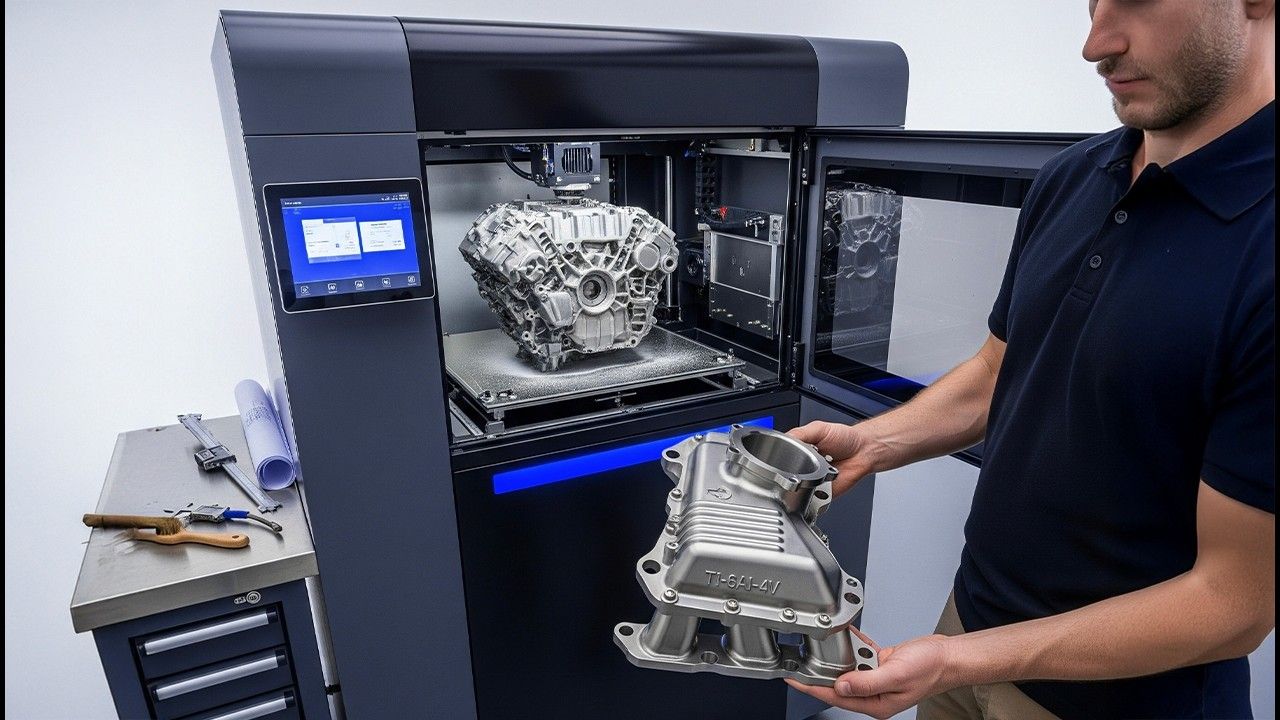
Metal 3d printing, often called metal additive manufacturing, is increasingly used in industries that require strong, complex, and precise components. From aerospace brackets to medical implants and industrial tooling, manufacturers are exploring these technologies because they can produce shapes that are difficult or impossible to make using traditional machining or casting.
How metal 3d printing works
Most metal printing systems follow a similar workflow:
-
A digital 3d model is created in CAD software
-
The file is sliced into thin layers
-
Metal powder is spread across a build platform
-
A laser or energy source melts the powder selectively
-
The platform lowers and the process repeats
-
The finished part is removed and post-processed
The two most widely discussed powder-bed fusion methods are DMLM and SLM.
DMLM vs SLM: what’s the difference?
In practice, DMLM and SLM are very similar and often used interchangeably. Both melt metal powder fully to produce dense parts. Differences typically relate to machine control, terminology, or proprietary system approaches rather than fundamentally different physics.
| Feature | DMLM | SLM |
|---|---|---|
| Powder fully melted | Yes | Yes |
| Density of parts | Very high | Very high |
| Common industries | Aerospace, medical, tooling | Aerospace, automotive, research |
| Materials used | Titanium, steel, aluminum | Similar material range |
| Post-processing required | Yes | Yes |
Other metal printing technologies include binder jetting, directed energy deposition, and hybrid systems that combine additive and machining operations.
Benefits of metal 3d printing
1. Design freedom
Complex internal channels, lattice structures, and weight-saving geometries can be printed directly. These designs often improve performance in heat transfer, structural efficiency, or fluid flow.
2. Material efficiency
Traditional subtractive machining removes material from a block, often producing significant waste. Additive manufacturing uses only the powder needed for the part, with excess powder reused.
3. Faster prototyping
Engineers can iterate quickly without building molds or tooling. This shortens product development timelines.
4. Part consolidation
Multiple components can be combined into a single printed structure, reducing assembly time and potential failure points.
5. Customization capability
Medical implants, tooling inserts, and specialized industrial components can be tailored to individual requirements.
Limitations to consider
Despite its advantages, metal printing is not always the best solution.
1. High equipment costs
Industrial machines and supporting infrastructure can require substantial investment.
2. Slow build speed
Compared to casting or forging for mass production, additive manufacturing can be slower per unit.
3. Post-processing needs
Most parts require heat treatment, machining, or surface finishing after printing.
4. Limited build size (for powder bed systems)
Although large-scale systems exist, many machines still restrict part size.
5. Skilled operation required
Material handling, machine calibration, and design optimization require trained specialists.
Types of metal 3d printing systems
Powder bed fusion systems
These are the most common industrial systems and include DMLM and SLM machines.
Typical uses:
-
Aerospace brackets
-
medical implants
-
precision tooling
-
lightweight structural parts
Directed energy deposition (DED)
DED systems feed powder or wire into a melt pool created by a laser or electron beam. They are often used for repair, large components, or hybrid manufacturing.
Typical uses:
-
turbine repair
-
large structural components
-
adding features to existing parts
Binder jetting systems
Binder jetting uses a binding agent to join metal powder, followed by sintering. It can produce parts faster and with lower thermal stress.
Typical uses:
-
tooling components
-
batch production parts
-
complex geometries requiring speed
Large-scale industrial systems
Large additive machines can produce components for energy, transport, and heavy machinery sectors. These systems may use wire feedstock or large powder beds.
Typical uses:
-
industrial molds
-
shipbuilding parts
-
heavy equipment structures
-
aerospace assemblies
Latest trends and innovations
Larger build platforms
Manufacturers are developing systems that can print larger components, reducing the need for welding or assembly.
Multi-laser machines
New machines use multiple lasers simultaneously, improving build speed and productivity.
Improved materials
Material research now includes high-strength steels, nickel superalloys, and specialized aluminum powders.
Hybrid manufacturing systems
Some machines integrate additive manufacturing with CNC machining to produce finished parts in one workflow.
Automation and monitoring
Advanced sensors and process monitoring help improve reliability and reduce defects.
Key features to consider when evaluating systems
When assessing a metal printing solution, several technical factors matter.
Build volume
Determines the maximum part size.
Material compatibility
Not all machines support the same metal powders.
Laser power and count
Higher power or multiple lasers improve productivity.
Powder handling and recycling
Efficient powder management reduces operating cost.
Software integration
Design optimization tools help engineers prepare parts for additive manufacturing.
Post-processing requirements
Consider whether finishing, heat treatment, or machining is needed.
Major companies and solutions in metal 3d printing
Several manufacturers produce widely used industrial systems:
-
EOS GmbH – known for powder-bed fusion machines used in aerospace and medical industries
-
SLM Solutions – specializes in multi-laser metal printing systems
-
GE Additive – produces industrial systems including electron beam machines
-
Desktop Metal – focuses on production-scale binder jetting technologies
-
Trumpf – provides laser metal fusion systems for industrial use
Comparing systems typically involves examining build size, material support, reliability, and industry adoption rather than simply looking at machine price.
How to choose the right metal 3d printing approach
Step-by-step selection checklist
1. Define part requirements
-
Strength level needed
-
surface finish requirements
-
dimensional accuracy targets
2. Determine production scale
-
prototype only
-
small batch production
-
continuous manufacturing
3. Select suitable process
-
Powder bed fusion for precision parts
-
DED for large or repaired components
-
binder jetting for faster production
4. Consider material availability
-
titanium for lightweight strength
-
steel for durability
-
aluminum for weight reduction
5. Evaluate total cost
Include:
-
machine cost
-
material cost
-
post-processing
-
operator training
Tips for best use and maintenance
Design for additive manufacturing
Parts designed specifically for printing often perform better and cost less than designs adapted from traditional methods.
Maintain powder quality
Contaminated powder can reduce part integrity. Proper storage and handling are essential.
Monitor build conditions
Temperature control, laser calibration, and machine maintenance affect part quality.
Plan post-processing early
Machining allowances, heat treatment steps, and finishing should be included in the workflow from the beginning.
Train operators thoroughly
Metal printing involves both manufacturing and materials science knowledge. Skilled operation improves consistency and reduces failure rates.
FAQs
Is metal 3d printing suitable for mass production?
It can be, but only for certain parts. High-value, complex components benefit most. For simple high-volume items, traditional manufacturing is often cheaper.
Are printed metal parts as strong as machined parts?
Yes, when produced correctly, they can match or exceed traditional material properties. Post-processing plays a major role.
What industries use metal additive manufacturing most?
Aerospace, medical, automotive, energy, and tooling industries are among the largest adopters.
Does metal printing reduce material waste?
In many cases, yes. Powder reuse and near-net-shape production reduce scrap compared to machining.
How expensive is metal 3d printing?
Costs vary widely depending on machine type, material, and production scale. It is often justified when design complexity or customization is important.
Conclusion: where metal 3d printing fits in modern manufacturing
Metal 3d printing is not a replacement for all traditional manufacturing methods, but it has become an important complementary technology. Its ability to produce complex geometries, reduce material waste, and enable rapid development makes it especially valuable for high-performance industrial applications.
As machines become larger, faster, and more automated, the role of additive manufacturing in production environments will likely expand. For engineers and manufacturers, understanding when and how to use these technologies is the key to unlocking their practical value.