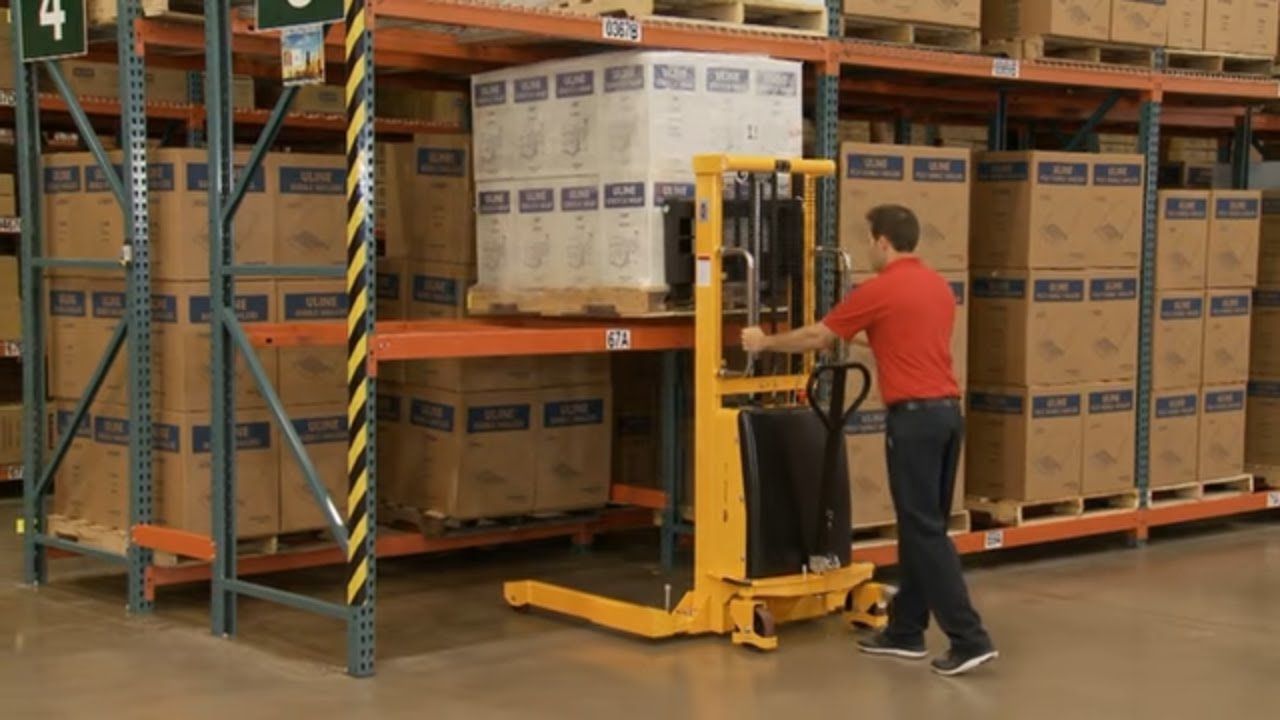
Modern warehouses and industrial facilities depend on efficient material handling systems to keep operations running smoothly. As storage density increases and supply chains become more time-sensitive, businesses need lifting equipment that is compact, reliable, and cost-effective. One widely used solution is the electric stacker.
Electric Stacker Equipment Guide for Warehousing & Industry
Introduction
Modern warehouses and industrial facilities depend on efficient material handling systems to keep operations running smoothly. As storage density increases and supply chains become more time-sensitive, businesses need lifting equipment that is compact, reliable, and cost-effective. One widely used solution is the electric stacker.
An electric stacker—sometimes referred to as a powered stacker or walk-behind pallet stacker—is a battery-operated lifting machine designed to raise, move, and stack palletized goods. It bridges the gap between manual pallet jacks and full-sized forklifts, offering controlled lifting in tighter spaces.
This guide explains how electric stackers work, their benefits and limitations, common types, key features, maintenance considerations, and how to choose the right model for your warehouse or industrial application.
What Is an Electric Stacker?
An electric stacker is a powered material-handling device used to lift and transport palletized loads. Unlike a traditional forklift, most electric stackers are walk-behind machines, meaning the operator walks alongside or behind the unit while controlling it.
They are commonly used in:
-
Warehouses
-
Distribution centers
-
Retail backrooms
-
Manufacturing facilities
-
Cold storage environments
Electric stackers are particularly useful in narrow aisles and areas where space is limited.
How Electric Stackers Work
Electric stackers operate using:
-
A rechargeable battery (typically lead-acid or lithium-ion)
-
An electric motor for travel
-
A hydraulic lifting system
-
Control handles with safety switches
When the operator activates the controls, the hydraulic system raises or lowers the forks. Powered drive models also allow forward and reverse movement without manual pushing.
Benefits of Electric Stackers
Electric stackers offer several advantages in warehouse and industrial settings.
1. Compact Design
They are smaller than forklifts, making them ideal for narrow aisles and confined storage spaces.
2. Reduced Physical Strain
Because lifting and movement are powered, operator fatigue is significantly reduced compared to manual equipment.
3. Lower Operating Costs
Electric stackers typically have lower fuel and maintenance costs compared to internal combustion forklifts.
4. Improved Safety
Many models include:
-
Automatic braking systems
-
Speed control
-
Emergency stop switches
-
Stability enhancements
5. Suitable for Indoor Use
Electric stackers produce no exhaust emissions, making them safe for enclosed environments.
Limitations of Electric Stackers
While useful, electric stackers are not suitable for every task.
1. Lower Load Capacity
Most stackers handle lighter loads compared to heavy-duty forklifts.
2. Limited Outdoor Capability
They are generally designed for smooth indoor surfaces, not uneven terrain.
3. Slower Travel Speeds
Stackers are optimized for controlled movement rather than high-speed transport.
4. Height Limitations
Although some models lift several meters, they may not reach the maximum heights of advanced forklift systems.
Understanding these limitations helps ensure the right equipment is selected for the task.
Types of Electric Stackers
Electric stackers come in several configurations, each suited to different applications.
1. Semi-Electric Stackers
-
Electric lift
-
Manual push movement
-
Lower cost option
-
Suitable for lighter workloads
Best for smaller warehouses or low-frequency use.
2. Fully Powered Stackers
-
Electric lift
-
Electric drive
-
Reduced operator effort
-
Higher efficiency
Ideal for medium to high usage environments.
3. Walk-Behind Pallet Stackers
-
Operated from behind
-
Compact footprint
-
Good for narrow aisles
Common in retail and logistics centers.
4. Straddle Stackers
-
Adjustable legs
-
Can handle closed-bottom pallets
-
Greater flexibility in pallet types
5. Counterbalance Stackers
-
No front support legs
-
Operate similarly to forklifts
-
Suitable where racking design requires front access
Comparison Table: Electric Stacker Types
| Feature | Semi-Electric | Fully Powered | Straddle | Counterbalance |
|---|---|---|---|---|
| Drive Type | Manual push | Electric drive | Electric/manual | Electric drive |
| Lift Height | Moderate | High | Moderate to High | High |
| Best For | Light duty | Medium duty | Mixed pallet types | Front-access racking |
| Cost Range | Lower | Moderate | Moderate | Higher |
| Operator Effort | Medium | Low | Low | Low |
Key Features to Consider
When evaluating electric stacker equipment, consider the following specifications:
1. Load Capacity
Common capacities range from 1 to 2 tons. Always match the equipment rating to your maximum pallet weight.
2. Lift Height
Choose a model that aligns with your racking system height.
3. Battery Type
-
Lead-acid: Lower initial cost
-
Lithium-ion: Faster charging, lower maintenance
4. Turning Radius
Important for narrow aisle operations.
5. Fork Dimensions
Ensure compatibility with pallet size.
6. Safety Systems
Look for:
-
Emergency stop
-
Anti-roll back
-
Speed limit controls
Latest Trends and Innovations
The material handling industry continues to evolve. Recent developments include:
1. Lithium-Ion Battery Integration
Faster charging and longer lifespan compared to traditional batteries.
2. Smart Monitoring Systems
Some advanced models provide:
-
Usage tracking
-
Battery health monitoring
-
Maintenance alerts
3. Ergonomic Enhancements
Improved control handles, smoother acceleration, and vibration reduction.
4. Compact High-Lift Models
Designed for higher storage density without increasing equipment footprint.
Leading Manufacturers and Industry Providers
Several globally recognized companies manufacture electric stackers and warehouse lifting equipment:
-
Toyota Material Handling (toyota-forklifts.com)
-
Crown Equipment Corporation (crown.com)
-
Jungheinrich (jungheinrich.com)
-
Hyster-Yale Group (hyster.com)
-
Raymond Corporation (raymondcorp.com)
These companies provide detailed product comparisons and specifications on their public websites, which can help users evaluate models and features.
How to Choose the Right Electric Stacker
Choosing the right equipment depends on operational needs.
Step 1: Assess Load Requirements
-
Maximum pallet weight
-
Frequency of lifting
Step 2: Evaluate Warehouse Layout
-
Aisle width
-
Rack height
-
Floor condition
Step 3: Determine Usage Intensity
-
Occasional use
-
Daily medium use
-
Continuous high-volume use
Step 4: Consider Budget and Lifecycle Costs
Factor in:
-
Initial purchase cost
-
Battery replacement
-
Maintenance
Step 5: Check Safety and Compliance
Ensure the equipment meets local workplace safety standards.
Electric Stacker vs Forklift: Quick Comparison
| Feature | Electric Stacker | Forklift |
|---|---|---|
| Size | Compact | Larger |
| Cost | Lower | Higher |
| Load Capacity | Moderate | High |
| Outdoor Use | Limited | Suitable |
| Operator Training | Moderate | Extensive |
Electric stackers are generally ideal for indoor stacking and controlled warehouse environments, while forklifts handle heavier and more demanding tasks.
Tips for Best Use and Maintenance
To extend the life of electric stackers:
1. Regular Battery Care
-
Follow recommended charging cycles
-
Avoid deep discharge when possible
2. Routine Inspections
Check:
-
Hydraulic systems
-
Brake functions
-
Fork integrity
3. Clean Operating Area
Keep floors free of debris to prevent mechanical strain.
4. Operator Training
Proper training reduces misuse and improves safety.
5. Scheduled Servicing
Follow manufacturer-recommended maintenance intervals.
Frequently Asked Questions
1. What is the typical lifespan of an electric stacker?
With proper maintenance, electric stackers can operate effectively for several years, depending on usage intensity.
2. Can electric stackers be used outdoors?
They are primarily designed for indoor use on smooth surfaces. Limited outdoor use may be possible on even concrete.
3. How high can electric stackers lift?
Lift heights vary by model, typically ranging from 3 to 6 meters.
4. Are electric stackers difficult to operate?
Most models are designed with user-friendly controls, but training is recommended.
5. What maintenance is required?
Routine checks of battery systems, hydraulics, and braking components are essential.
Practical Checklist Before Purchasing
-
Confirm load capacity requirements
-
Measure aisle widths
-
Check lift height compatibility
-
Compare battery types
-
Review manufacturer safety features
-
Plan for maintenance and service access
Conclusion
Electric stackers play an important role in modern warehousing and industrial operations. They provide a practical balance between manual pallet handling and full-scale forklift systems. Their compact design, lower operating costs, and indoor suitability make them valuable tools for many businesses.
However, selecting the right model requires careful evaluation of load capacity, lift height, warehouse layout, and usage frequency. By understanding the types, features, and limitations discussed in this guide, decision-makers can choose equipment that aligns with operational goals while maintaining safety and efficiency.
In a rapidly evolving logistics landscape, well-chosen material handling equipment contributes to smoother workflows, improved safety, and better space utilization. Electric stackers remain a reliable option for organizations seeking efficient and adaptable warehouse solutions.