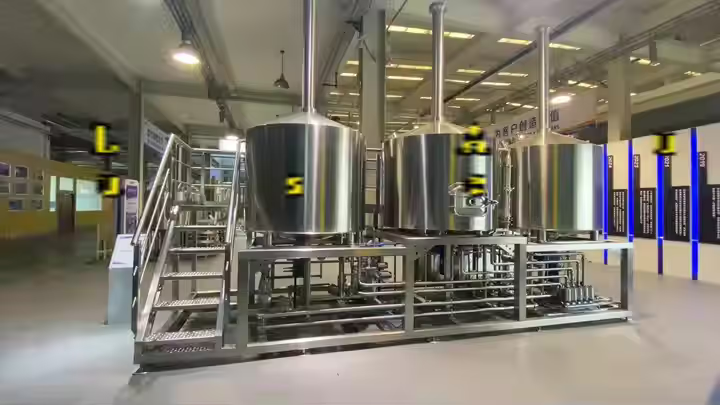
Beer production has evolved from small, manual processes to highly controlled industrial operations. Whether at a craft scale or in large facilities, the quality and consistency of beer depend heavily on the equipment used during brewing and fermentation.
What Is Beer Brewing Equipment?
Beer brewing equipment refers to the machines and systems used to convert raw ingredients—such as water, malt, hops, and yeast—into beer. These systems are typically divided into two main categories:
- Brewhouse systems, where wort is produced
- Fermentation systems, where wort is converted into beer
Additional supporting equipment may include pumps, heat exchangers, and storage tanks.
Overview of the Brewing Process
Understanding the brewing process helps clarify the role of different equipment.
Key Stages
- Mashing – Mixing crushed grains with hot water to extract sugars
- Lautering – Separating liquid wort from solid grain residue
- Boiling – Heating wort and adding hops
- Cooling – Preparing wort for fermentation
- Fermentation – Yeast converts sugars into alcohol
- Conditioning – Enhancing flavor and stability
Each stage requires specific equipment and controlled conditions.
Benefits of Modern Brewing Equipment
1. Process Consistency
Modern systems allow precise control over temperature, pressure, and timing.
2. Improved Efficiency
Automated equipment reduces manual effort and increases output.
3. Scalability
Brewing systems can be adapted for small or large-scale production.
4. Better Quality Control
Advanced monitoring ensures consistent flavor and product quality.
5. Reduced Waste
Efficient systems minimize raw material loss.
Limitations and Considerations
1. High Initial Investment
Industrial brewing systems can be costly to install.
2. Technical Complexity
Operation may require trained personnel.
3. Maintenance Requirements
Regular cleaning and inspection are necessary.
4. Space Requirements
Large systems need significant floor space.
Types of Beer Brewing Equipment
Brewing equipment can be categorized based on function and scale.
1. Brewhouse Systems
Brewhouse systems are responsible for producing wort, the liquid that becomes beer after fermentation.
Common configurations:
- Two-vessel systems
- Three-vessel systems
- Four-vessel systems
Functions:
- Mashing
- Lautering
- Boiling
These systems are typically made of stainless steel and include heating and mixing mechanisms.
2. Fermentation Equipment
Fermentation is where yeast converts sugars into alcohol and carbon dioxide.
Types of fermenters:
- Open fermenters
- Closed fermenters
- Conical fermenters
Features:
- Temperature control
- Pressure regulation
- Easy cleaning systems
3. Small and Mini Brewing Equipment
These systems are designed for smaller production scales.
Advantages:
- Lower cost
- Compact size
- Suitable for experimentation and learning
Applications:
- Craft brewing
- Pilot production
- Educational use
4. Large-Scale Brewing Equipment
Used in industrial settings for high-volume production.
Characteristics:
- High capacity
- Automation
- Integration with other systems
Applications:
- Commercial breweries
- Beverage manufacturing plants
5. Auxiliary Equipment
Supporting equipment ensures smooth operation.
Examples:
- Pumps for liquid transfer
- Heat exchangers for cooling
- Storage tanks
- Cleaning systems (CIP – Clean-In-Place)
Comparison Table of Brewing Equipment Types
| Equipment Type | Function | Scale | Key Advantage | Complexity |
|---|---|---|---|---|
| Brewhouse system | Wort production | All scales | Core process control | Medium |
| Fermentation tanks | Alcohol production | All scales | Quality control | Medium |
| Mini brewing equipment | Small batch brewing | Small | Compact and flexible | Low |
| Large-scale equipment | Mass production | Industrial | High output | High |
| Auxiliary equipment | Support processes | All scales | Efficiency | Medium |
Working Principles of Brewing Equipment
Brewhouse Operation
- Grains are mixed with hot water in a mash tun
- Enzymes convert starch into fermentable sugars
- Wort is separated and boiled with hops
- The mixture is cooled before fermentation
Fermentation Process
- Yeast is added to cooled wort
- Sugars are converted into alcohol
- Temperature and pressure are controlled
- Fermentation time varies depending on beer type
Industrial Applications
Beer brewing equipment is used in various settings:
Commercial Breweries
Large-scale production for distribution.
Craft Breweries
Smaller operations focused on specialty products.
Research and Development
Testing new recipes and processes.
Educational Institutions
Teaching brewing science and engineering.
Latest Trends and Innovations
Automation and Digital Control
Modern systems use sensors and software for precise control.
Energy Efficiency
New equipment designs reduce energy consumption.
Modular Brewing Systems
Flexible setups allow expansion as production grows.
Improved Cleaning Systems
Advanced CIP systems improve hygiene and reduce downtime.
Key Features to Consider
| Feature | Importance |
|---|---|
| Capacity | Determines production volume |
| Material quality | Ensures durability and hygiene |
| Temperature control | Critical for brewing accuracy |
| Automation level | Impacts efficiency |
| Cleaning system | Affects maintenance ease |
| Space requirements | Influences installation |
Major Manufacturers and Industry Solutions
Several global companies provide brewing equipment and solutions:
- Alfa Laval
- GEA Group
- Krones AG
- Paul Mueller Company
- Ss Brewtech
These companies offer equipment ranging from small brewing systems to large industrial installations. When comparing options, users often consider:
- System reliability
- Process efficiency
- Ease of integration
- Technical support availability
How to Choose the Right Brewing Equipment
Step 1: Define Production Scale
Determine whether the requirement is small-scale, pilot, or industrial.
Step 2: Identify Process Needs
Consider the type of beer and production complexity.
Step 3: Evaluate Space and Layout
Ensure adequate space for installation and operation.
Step 4: Consider Automation Level
Choose between manual, semi-automated, or fully automated systems.
Step 5: Assess Budget and Long-Term Use
Balance initial cost with operational efficiency.
Selection Checklist
- Desired production capacity
- Type of brewing system
- Fermentation requirements
- Available space
- Level of automation
- Maintenance needs
Tips for Best Use and Maintenance
Maintain Cleanliness
Regular cleaning is essential to prevent contamination.
Monitor Temperature
Consistent temperature control improves product quality.
Inspect Equipment Regularly
Check for wear and tear in components.
Use Proper Materials
Ensure compatibility with brewing ingredients.
Train Operators
Proper training improves efficiency and reduces errors.
Frequently Asked Questions
What is the role of a brewhouse system?
It is used to produce wort by processing raw ingredients through mashing, boiling, and separation.
Why is fermentation equipment important?
It controls the conversion of sugars into alcohol, which defines the final product.
Can brewing equipment be used at different scales?
Yes, systems are available for small, medium, and large-scale production.
What materials are commonly used?
Stainless steel is widely used due to its durability and hygiene.
How often should equipment be cleaned?
Cleaning should be done regularly, especially after each production cycle.
Conclusion
Beer brewing equipment forms the backbone of the brewing process, enabling consistent and efficient production across different scales. From brewhouse systems that prepare wort to fermentation tanks that transform it into beer, each component plays a specific role in achieving the desired outcome.
Understanding the types, working principles, and features of brewing equipment helps users make informed decisions based on their needs. While modern systems offer advanced capabilities, proper operation and maintenance remain essential for reliable performance.
As brewing technology continues to evolve, equipment is becoming more efficient, adaptable, and precise, supporting both small-scale experimentation and large-scale production.